PITCH
Closer is higher
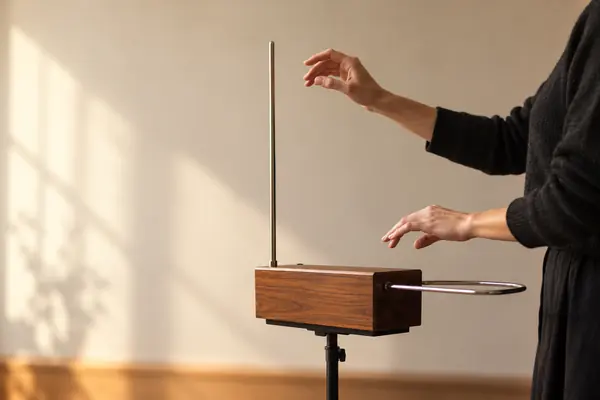
The pitch antenna senses the capacitance of the player's hand. Move the hand closer and the note rises; move it away and it falls.
Try a hand move soundboardplay
Start
THE INSTRUMENT YOU NEVER TOUCH
The theremin is played without any physical contact at all.
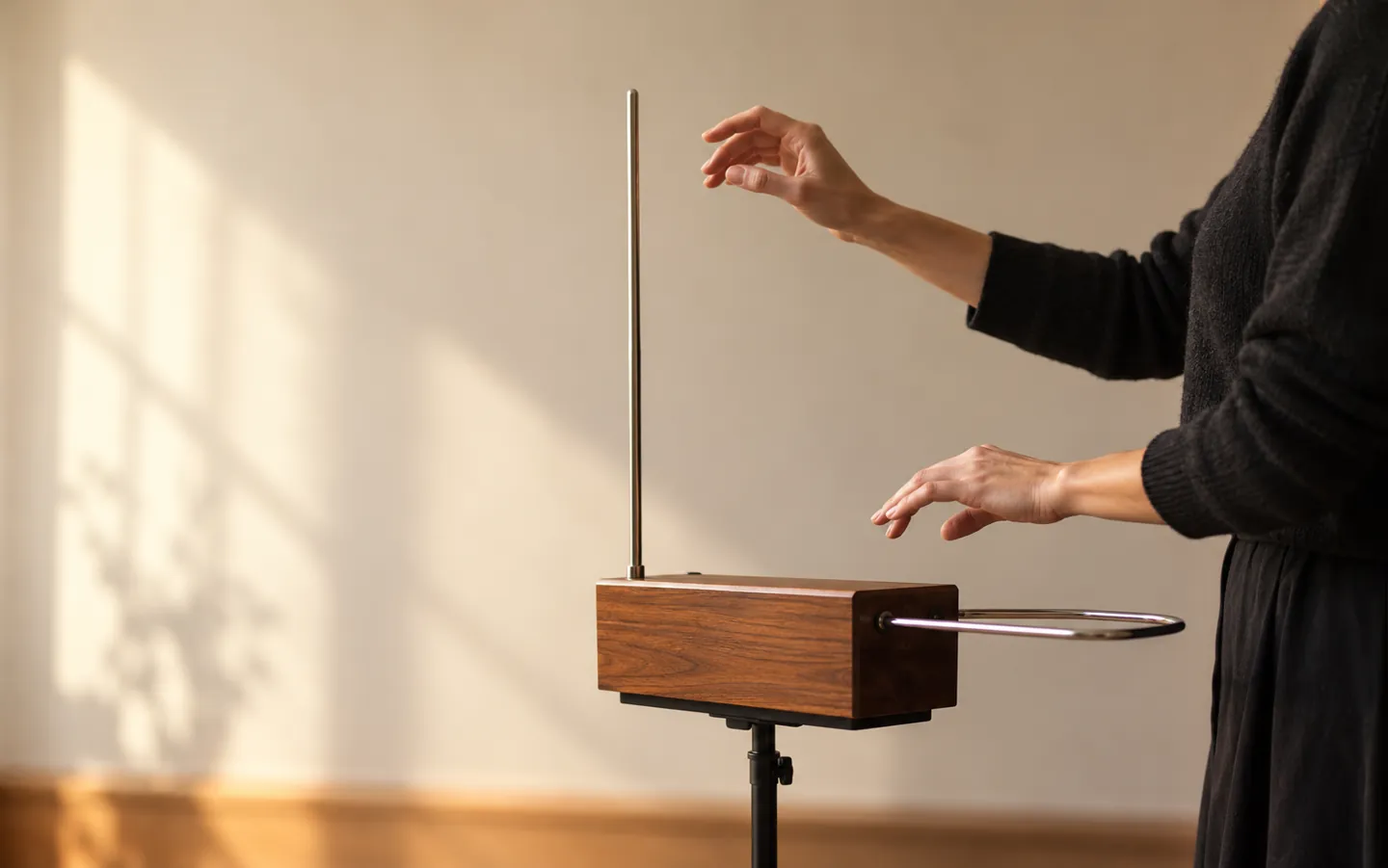
Invented around 1920 by the Russian physicist Lev Termen, known in the West as Léon Theremin, it senses how close your hands are to two metal antennas. One hand sets the pitch, the other the volume, and the result is the eerie, gliding sound of old science-fiction films.
NO CONTACTone antenna for pitch, one for volume
Try a hand moveKeep in mind
THE SHORT ANSWER
Two antennas, two hands.
Closer to the pitch antenna means higher.
PITCH
The pitch antenna senses the capacitance of the player's hand. Move the hand closer and the note rises; move it away and it falls.
Try a hand moveINSIDE
Two very high-frequency oscillators run at around 350 kHz. One is fixed, the hand nudges the other, and the difference between them is the note you hear.
See the numbersHISTORY
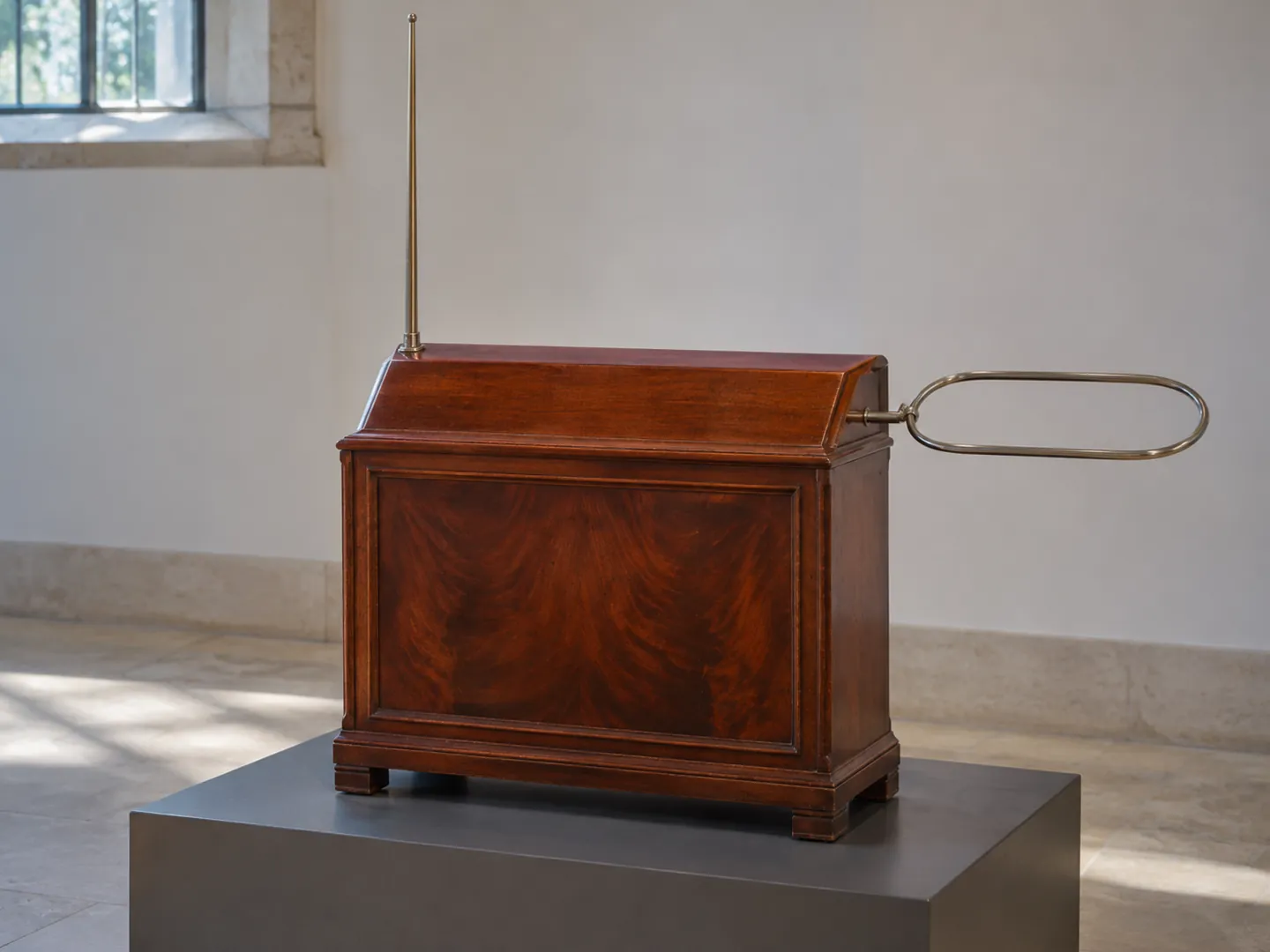
RCA made about 500 theremins in 1929, of which around 120 survive. The Science Museum Group and the Met both hold one.
Read the storyA QUICK HAND CHECK
Pick a hand movement. The bar shows what happens to the note: lower, the same note at a new volume, or higher.
Based on the University of Rhode Island explainer on how the theremin works. Some players set the volume antenna to work the other way round.
TWO NUMBERS WORTH KNOWING
One figure from the circuit,
one from the factory.
0.05%
Change in the variable oscillator that can span about five octaves
Because the note is the difference between two oscillators near 350 kHz, a very small shift in one of them is a large change at audio frequency, enough for a range of about five octaves.
THE CIRCUIT · URI
≈ 500
Theremins RCA made in 1929
RCA's 1929 model was one of the first electronic instruments for home use. Around 120 survive. Its price, the Great Depression and how hard it is to play accurately kept it from mass popularity.
THE FACTORY · THE MET
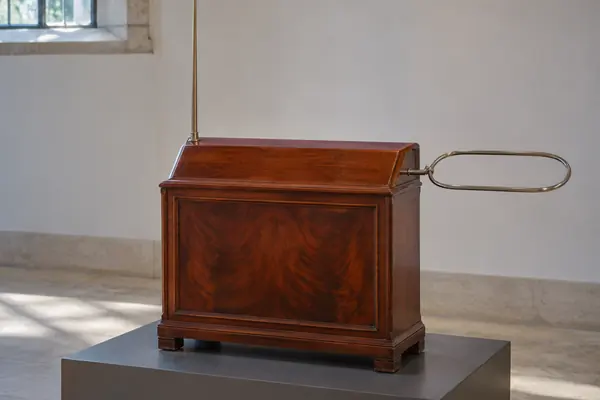
The Science Museum Group's RCA theremin, number 67 of the 500, has a pitch range of 3.5 to 4 octaves and valves (vacuum tubes) inside its mahogany cabinet.
HOW A PLAYER STARTS
There is nothing to press, so every note depends on where your hands are in the air. These steps follow how the instrument is built.
Step 1
On the classic design the upright antenna controls pitch and the horizontal one controls volume, played by the right and left hands.
Step 2
With no keys or frets, the note slides as the hand moves. Players listen and adjust, much as a violinist does without frets.
Step 3
The left hand raises and lowers the volume, so it can start and stop notes and keep the gliding pitch from sounding like one long slide.
Step 4
The antennas respond to whatever comes close, so steady posture matters: the pitch follows the capacitance of the hand or anything else nearby.
A HUNDRED YEARS OF ETHER MUSIC

Around 1920 Theremin was working on proximity sensing, including an early alarm that sounded when a person came near. He first called his instrument the aetherphon. A 1922 demonstration impressed Lenin, and from December 1927 Theremin toured the United States, playing major venues including Carnegie Hall.
The violinist Clara Rockmore (1911–1998) became its best-known virtuoso in the 1930s and 1940s and showed it was more than a gadget. In 1951 its sound accompanied the robot in The Day the Earth Stood Still. Theremin returned to the Soviet Union in 1938, where he built a passive listening device, and he lived to the age of 97.
Questions
No. The player moves their hands near two antennas, one for pitch and one for volume, without touching the instrument.
The Russian physicist Lev Sergeyevich Termen, known in the West as Léon Theremin, invented it around 1920.
There are no keys or frets, so the pitch depends only on where the hand is in the air. The Met notes that the difficulty of playing it accurately helped keep it from mass popularity.
Two high-frequency oscillators run at around 350 kHz. The hand changes one of them, and the difference between the two, the beat frequency, becomes the audible note, which is then amplified and sent to a speaker.
According to the Linda Hall Library, no. What sounds like a theremin in the opening credits is a soprano imitating one. Many other science-fiction films did use it.
Destination
Updated
ABOUT THIS NAME
soundboardplay.com is part of the DoodleSale portfolio. It isn't in an auction right now, but you can ask about leasing it.